
The Technology
What makes PhysioKey different?
PhysioKey is a German-developed electrotherapy device using a technology known as bioadaptive neurostimulation.
Unlike a device that delivers an entirely fixed electrical signal, PhysioKey measures electrical resistance and impedance at the skin and adapts its impulses as those measurements change.
These electrical impulses stimulate sensory nerves through the skin. The intensity, programme and application are selected by the practitioner, with the horse's comfort and response guiding treatment.
In simple terms
The device continually adjusts its electrical output in response to what it measures at the skin. This does not mean it diagnoses an injury.
The Treatment
Why might I use PhysioKey?
PhysioKey can be considered as part of an individual bodywork programme. Its suitability and response vary between horses.
Muscle tension & comfort
Muscles can develop areas of increased tension through exercise, repetitive movement or compensating for discomfort elsewhere. Targeted massage uses different pressures and techniques to help reduce muscular guarding and encourage the tissues to relax.
Circulation & tissue health
Massage applies mechanical pressure to soft tissues and can temporarily increase local skin and superficial tissue blood flow. These effects may support tissue comfort, although massage does not replace the body's natural recovery processes.
Movement & flexibility
Muscles and surrounding connective tissues need to move comfortably against one another. By addressing soft-tissue tension and working with the horse's responses, massage may help improve ease of movement and short-term flexibility.
Nervous system & relaxation
Touch provides sensory information to the nervous system. Calm, appropriately paced massage may encourage relaxation and reduce protective muscle guarding, particularly when the horse feels safe and has time to accept treatment.
Supporting muscular health & reducing avoidable strain
Muscular tension, fatigue and changes in movement can sometimes indicate that a horse is struggling with the demands placed on its body. Regular massage appointments provide an opportunity to monitor muscular condition, identify changes in sensitivity or tension, and discuss potential concerns before they become more significant.
Combined with appropriate conditioning, workload management, saddle fit and veterinary care, massage can form part of a proactive approach to supporting your horse's musculoskeletal health.
Supporting recovery & rehabilitation
Whether a horse is returning to work after time off, recovering from demanding exercise or following a veterinary rehabilitation programme, its muscles may need additional support as activity changes. Appropriately timed massage can help manage muscular tension and guarding, support comfort and provide an opportunity to monitor how the horse responds as its workload gradually increases. For horses recovering from injury, massage is adapted to their stage of healing and used alongside veterinary guidance and a structured rehabilitation plan.
Individual Treatment
Different programmes. Different approaches.
PhysioKey has a range of programmes with different electrical settings. These are selected according to the treatment objective, the horse's presentation and its response.
Basic
The starting programme used to introduce treatment and observe differences in the device's response across an area.
Relaxation
A programme described in the training for muscular tension and restricted movement.
Harmonisation
A separate programme within the device's bioadaptive treatment options.
Trigger
A programme option used within more focused treatment approaches.
Sedation
A programme described in the training for applications where a calming or sedating effect is intended.
Activation
A programme described in the training for stimulation-oriented applications.
These are manufacturer programme names and intended applications, not guarantees of a particular clinical outcome. Programme choice and intensity are practitioner decisions.
What to Expect
What happens during a session?
I begin by discussing your horse's history and observing their behaviour and muscular responses.
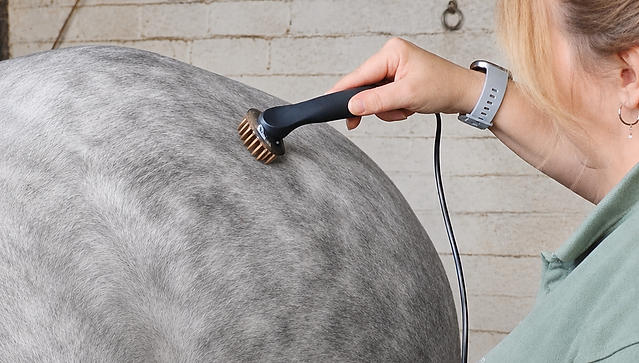
The device is introduced carefully, with the settings adapted to the horse. It may be moved across an area or held in place briefly, depending on the treatment approach.
I continually watch for changes in posture, expression, movement and willingness to accept contact.
My Horse Led Approach
Sometimes, less hands-on is more.
Some horses are uncomfortable with direct pressure, particularly when they are anxious, sensitive or protective of an area.
This is one reason I may choose PhysioKey before introducing massage. It gives me another approach to consider without immediately asking the horse to accept deeper manual techniques.
I don't assume that a quiet horse is necessarily a relaxed horse. I look at their whole body language, including breathing, facial expression, muscle tension and whether they choose to remain engaged.
The horse decides the pace.
If they move away, become unsettled or show discomfort, I adjust the treatment, give them time or stop altogether.
Observing Your Horse
What might you notice?
Horses communicate constantly during treatment. Small changes can tell us whether an approach is being accepted or whether we need to reassess.
Head & neck
A change in head carriage, neck position or willingness to stretch.
Movement
Weight shifting, stepping away, standing differently or repositioning.
Eyes & expression
Changes in eye softness, facial tension or attention.
Other behaviours
Licking, chewing, yawning, ear movement or periods of stillness.
No single behaviour proves that treatment is working or that a horse is relaxed. Each response must be considered in context.
Safety First
Is PhysioKey suitable for every horse?
No. Electrical stimulation isn't suitable in every situation. Before treatment, I consider the horse's medical history, current health, any veterinary diagnosis and the device's contraindications.
The training identifies precautions including pregnancy, infection or fever, tumours, fresh thrombosis and electronically controlled implants.
Unexplained pain, new lameness or suspected injury should be assessed by a vet. PhysioKey does not replace veterinary diagnosis or treatment.
Your Horses Treament
Could PhysioKey be right for your horse?
Not every horse needs the same treatment. Whether yours is sensitive to touch, has areas of muscular tension or requires a more gradual approach, we can discuss what may be suitable.
PhysioKey may be incorporated into a wider bodywork session, with massage or other appropriate techniques selected according to your horse's needs.
Based in Letchworth Garden City
Covering Hertfordshire, Bedfordshire and surrounding areas. North West London and further afield by arrangement.